

Fiscal dominance
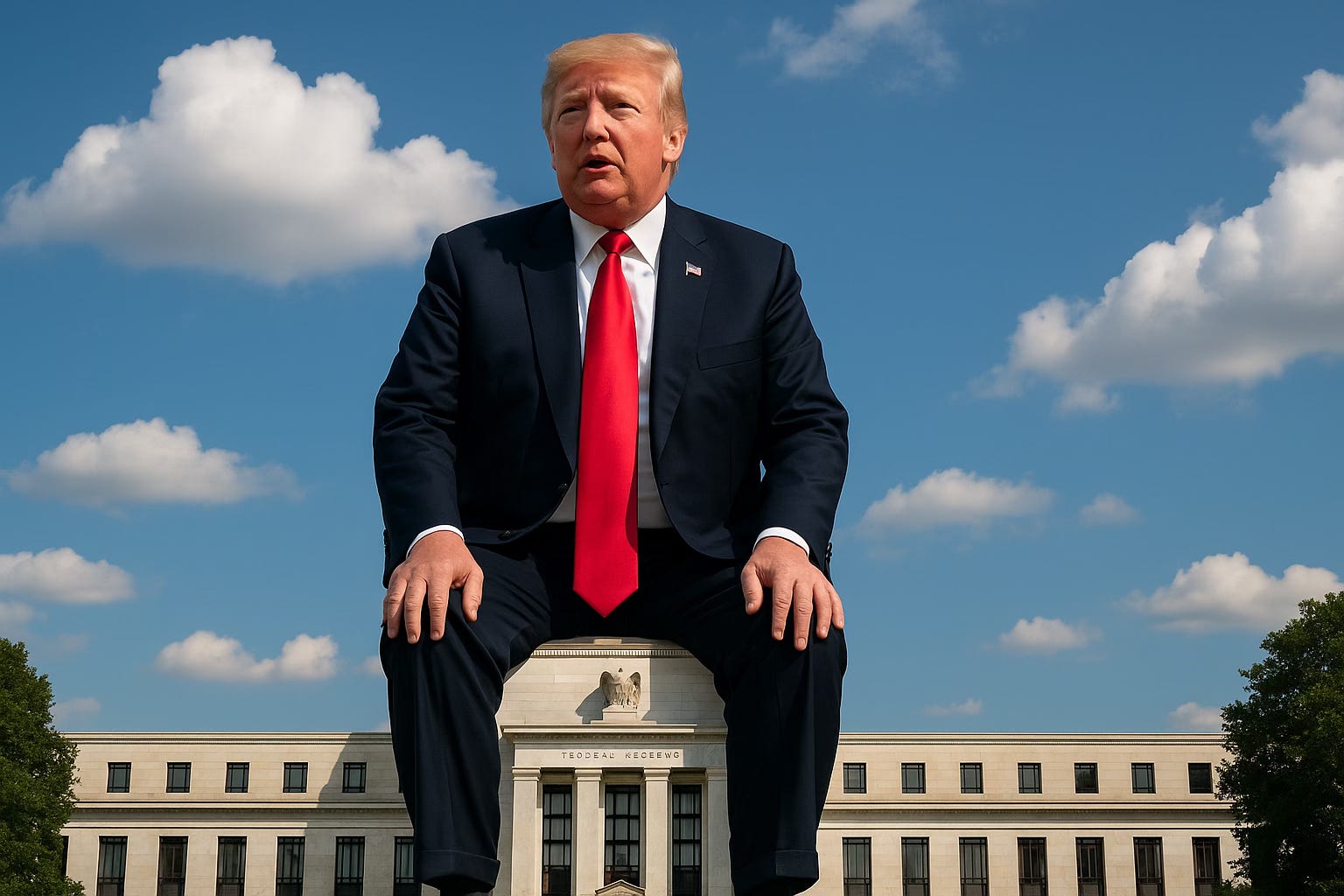
“Fiscal dominance” is a phrase that you hear a lot these days. Judging by its use, it isn’t clear to me that the concept is well understood by many opining on it. The vague definitions of the term proffered by economists don’t help. The picture also is clouded by politics. Much of the conversation assumes fiscal dominance and frames it as a new phenomenon rather than ongoing. President Trump’s verbal assault on the Fed explains much of the increase in both discussion of fiscal dominance and market pricing of its risk. Yet, as is often the case with President Trump, his rhetoric may be less prophetic and more akin to the boy in the story of the emperor’s new clothes, calling attention to the obvious thing everyone is trying to ignore.
Or regulatory dominance?
I was prompted to write about fiscal dominance by a speech last week given by Fed Governor Stephen Miran that connects the topic to the related concept of financial repression.1 As foreshadowed by the title of Governor Miran’s speech – “Regulatory Dominance of the Federal Reserve’s Balance Sheet” – the two concepts are tightly interlinked by regulation. I’ve written previously that Governor Miran is best seen as a loyal emissary of President Trump, providing intellectual justifications for his administration’s economic policies. Keeping in mind Governor Miran’s partisanship, it is worth digging into his speech both for its insights into the current state of fiscal dominance and how the Trump Administration might approach it.
Defining dominance
At its simplest, fiscal dominance refers to a government coercing or legally requiring its central bank to prioritize funding government debt over another goal like inflation or currency stability. Typically, monetary policy, the management of the money supply relative to a nominal target (e.g. the price of a commodity like gold, a fixed or crawling exchange rate peg, or a price level or inflation target), is delegated to an independent central bank to separate it from fiscal policy (government expenditure, taxation and debt management). This is to prevent fiscal authorities from using monetary policy to ease debt management, which might cause the money supply to deviate from its nominal target. But when the fiscal authorities mismanage government debt, the temptation to pull back central bank independence may become too great, leading the fiscal authority to “dominate” the monetary authority.
Defining deviancy downward
The above definition is more explicit than the typical economist definition yet is too narrow in another regard. Most economists define fiscal dominance as any situation where the fiscal authority is on an unsustainable debt path.2 That definition suffers from a few problems including the definition of unsustainability (when precisely do you cross the path of no return?) and that fiscal authorities may impose their will far earlier or chose default over monetization. But the definition isn’t broad enough in another critical dimension: financial repression.3 If you need credit and have sovereign power, why stop (or even start) with the central bank when you can require commercial banks, insurers, pension funds, and other large pools of private capital to buy your debt?
Help! I’m being repressed!
Historically, indebted governments also raid private piggy banks for funding, often before “dominating” the central bank.4 Financial regulation is the cudgel governments use to force banks, insurers, pension funds, and any other large pools of capital to buy its debt. Governor Miran’s “Regulatory Dominance” is not just a partisan rhetorical artifice, it strikes to the core of the complex interaction between fiscal dominance and financial repression. As Governor Miran highlights, financial reforms enacted after the Global Financial Crisis (GFC), including investing the Federal Reserve with greater regulatory responsibilities, have more intricately entangled the two concepts with the Fed’s own operations.
Buckle up, this is gonna hurt
To see how, one needs to understand at a basic level the Basel III international regulatory framework adopted by (and to be fair, largely shaped by) the US in the wake of the GFC. You’d better grab a cup of coffee – and perhaps some aspirin – as this will require all your mental faculties and is likely to hurt (a lot).
Maximize “normal;” minimize “crises”
Banks are leveraged financial institutions, i.e. their equity capital is only a fraction of their total assets, with debt (mostly deposits) financing the rest.5 This is what makes them subject to runs: if enough depositors lose faith in the financial soundness of a bank’s assets and withdraw their funds at once, the bank collapses. As Governor Miran rightly notes the objective of efficient regulation is to maximize banks’ ability to extend credit to the economy in “normal” times while minimizing the risk of a bank failure in “crises.“ Governor Miran makes clear that he thinks that, following the GFC, legislators erred too far in the direction of minimizing crises at the expense of credit provision during normal times. He suggests that this results, in part, from undue complexity and implies it has both created financial repression and opened the door to fiscal dominance.
Banks are now safe...oops!
To make banks safer, Basel III set forth four balance-sheet ratios that banks must meet, three that apply to their assets and a fourth that applies to their liabilities. Because it isn’t directly relevant to the discussion here, I’ll skip the net-stable-funding ratio (NSFR) that applies to bank liabilities other than to note that it did nothing to prevent the deposit concentration problems that led to regional bank failures in the US in 2023. It is a good illustration of the fact that there are no perfect regulations – fractional reserve banking is inherently unstable and will always be subject to periodic failures – and that overly complex regulations like Basel III may even contribute to bank failures by distracting bank regulators from the basics (like concentration risk).
Chapter VIII, §14(1).A7: Rule 23c, Subparagraph 3(iv), requires...
The real complexity of Basel III rules lies on the asset side where overlapping, sometimes contradictory constraints shape banks’ balance sheets. Banks must simultaneously meet the following three ratios:
The Liquidity Coverage Ratio (LCR) requires banks to hold sufficient “high-quality, liquid assets” (HQLA), defined as reserves with the central bank or government debt securities (i.e. US Treasuries), to meet 30-days liquidity needs in the event of “stressed” deposit outflows;
The Risk-Weighted-Asset (RWA) capital ratio limits the size and composition of a bank’s balance sheet relative to its capital,6 with assets weighted by their risk as defined by regulators and – important to the topic at hand – government debt is assigned zero risk weight, meaning no capital needs to be held against it;
The Leverage Ratio (LR) caps the total size of a bank’s balance sheet (and off-balance-sheet exposures) relative to its capital holdings, ensuring that banks cannot deploy infinite leverage against a balance sheet comprised solely of government securities.
Please buy our Treasuries...but not too many
If you are confused, or see manifold financial oxymoronisms embedded in those three ratios, you would not be the first, even among professionals. But let’s focus on how they directly relate to financial repression and fiscal dominance. The LCR requires and the RWA capital requirement strongly encourages banks to buy Treasuries, while the LR constrains their ability to. The contradiction between the LR and the other asset ratios caused problems during Covid when demand for Treasuries spiked among both banks and their customers – who needed banks to broker them – forcing the Fed to adopt temporarily the “enhanced Supplementary Leverage Ratio” (eSLR) that exempted banks from restrictions on Treasury purchases. But surprisingly, the LCR also encourages the Fed to buy Treasuries, as Governor Miran notes.
Financially repressing the Fed
One of Governor Miran’s key points is that the Fed’s supersized balance sheet is not only a function of nearly two decades of “quantitative easing” (QE), or bond purchases at the zero lower bound for interest rates. It also results from the LCR. Because reserves also qualify as HQLA and often are preferred by banks, the Fed is required to create “ample” reserves to meet banks’ LCR demand by buying Treasuries. This is the cause of all the hysterics about “quantitative tightening” (QT) and “liquidity.” As the Fed sells off its Treasury portfolio, taking reserves back from banks in exchange, banks are left with fewer reserves to meet the LCR. Hence, the Basel III regulations not only encourage banks to hold large quantities of Treasuries, but they also force the Fed to buy Treasuries to meet banks’ increased demand for reserves. Governor Miran notes that Fed regulators make this problem worse for themselves by encouraging banks’ preference for reserves over Treasuries.
You know it when you see it
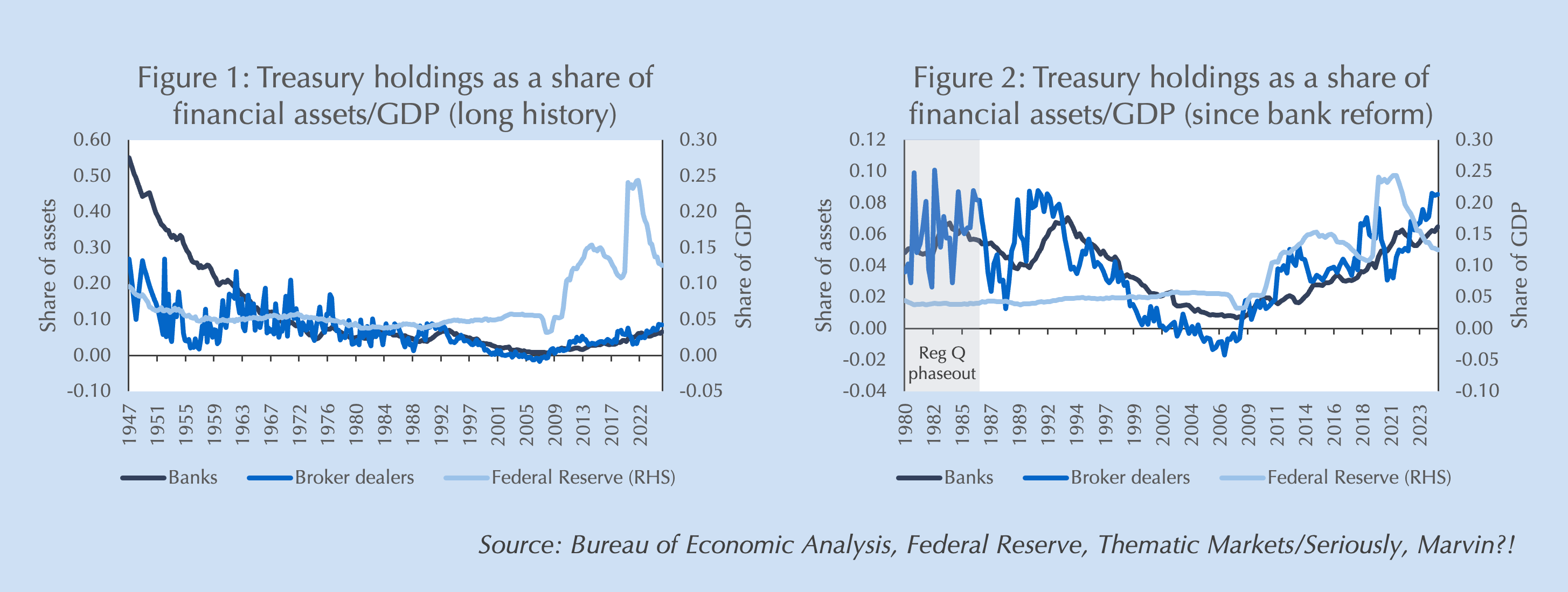
While Governor Miran does not explicitly state that the post-GFC regulatory framework creates a regime of financial repression and steers the Fed on a course of fiscal dominance, he strongly implies it. Given the complexity of the issues and the difficulty in striking the right balance in regulation between “maximizing normal and minimizing crises,” assessing whether he is right is akin to Justice Potter Stewart’s famous determination of pornography “I know it when I see it.”7 Figure 1 presents the post-War history of Treasury holdings of commercial banks, broker dealers, and the Federal Reserve. Because banks share of credit creation has fallen over the last few decades, I present their Treasury holdings as a portfolio “choice” – to the extent regulations allow – i.e. as a share of their total assets. For the Federal Reserve, Treasuries are shown as a share of GDP since their portfolio choice is more limited by Congress.
Nothing to see here?
The recent rise in financial institutions’ Treasury holdings appears minor compared with the decades immediately following World War II and the historical aberration seems to be the low level of holdings in the 2000s. Yet this ignores the US history of financial repression. Economic historians specifically identify the period from WWII to 1980, when banks were freed from interest rate controls (Regulation Q), as one of financial repression and fiscal dominance.8 The higher share of Fed Treasury holdings before the 1951 Treasury-Fed Accord that ended the Fed’s capping of Treasury yields – which is dwarfed by its share in the last 15 years – also testifies to explicit fiscal dominance. Hence, it would be more appropriate to see the period before the mid-1980s when Reg Q was fully phased out as an example of financial repression than as “normal.”
“Normal” or “bubble” 2000s?
Concentrating on the post-Reg Q period shown in Figure 2, the low level of bank Treasury holdings in the late 1990s and early 2000s may better reflect “normal” portfolio choice after a period of rapid financial innovation expanded the menu of alternatives. However, that period also incubated the housing crisis that may have distorted normal Treasury holdings. The truth likely lies in between: the 2000s may have been unusually low, but the post-GFC period likely is abnormally high and testifies to financial repression.
Other signs of repression and fiscal dominance
That mixed interpretation is supported by other indicators. For instance, the equity prices of many large banks in the post-GFC period have traded below book value for sustained periods, suggesting that the only way for them to generate a return on capital equivalent to the broader economy – which their earnings, in theory are meant to reflect – is with undervalued assets.9 Financial repression also is apparent in banks’ “window-dressing” demand for Treasuries (i.e. for quarter-end balance sheet statements and annual regulatory stress tests), suggesting that their preferred holdings of Treasuries would be much lower.
The elephant in the room
But the largest sign of financial repression and potential fiscal dominance is the one that stands out as aberrant over any period, even in Figure 1, the size of the Fed’s balance sheet. Recall Governor Miran’s point that banks’ preference for reserves over Treasuries to meet the LCR shifts significant regulation-driven demand onto the Fed. Hence, banks’ actual Treasury holdings, if anything, understate the degree of financial repression. Governor Miran, partisan as he is, is not alone; several other economists have made this point over the last decade.10
Where from here?
If we already live in a world of fiscal dominance and financial repression, where are we going from here? As noted, President Trump’s push for the Fed to actively lower debt service costs seems scarily similar to the explicit fiscal dominance of the post-WWII period. Yet, despite that rhetoric – and alignment of Governor Miran’s policy votes with it – the Administration’s consistent and vocal stances on both regulations and Fed operations argue in the opposite direction. While some commentators have pointed to Governor Miran’s advocacy for new LR exemptions as an expression of fiscal dominance, that interpretation ignores that the whole thrust of his speech is to remove regulations like the LCR that force the Fed to have a larger balance sheet and banks to hold Treasuries. Further, Governor Miran’s position is wholly consistent with that expressed by Secretary Bessent in a September Op-Ed: that the Fed’s balance sheet needs to be shrunk dramatically.11
A funny type of fiscal dominance
This raises an important question: how do you effect fiscal dominance if you shrink the central bank’s balance sheet and free commercial banks from requirements to hold Treasuries? Those policies seem entirely at odds with fiscal dominance and financial repression. There are two possible answers. I posed the first earlier this year in A hawk in dove’s clothing?; i.e. that President Trump’s low-rate rhetoric is a rhetorical ploy that meets his near-term political needs but is not reflective of his true policy intent. His “rope-a-dope” verbal acrobatics on L’Affaire d’Epstein give credence to that interpretation. This would suggest that markets underprice frontend interest rates. But it doesn’t eliminate the longer-term risk of a return to fiscal dominance; only more credible action on constraining fiscal expenditure will do that.
Stablecoins to the rescue?
The alternative is that financial repression and fiscal dominance are being shifted from the central bank and commercial banks to stablecoins. Secretary Bessent often highlights that he sees stablecoin issuance as a large, stable source of demand for T-bills. However, there are a few problems with this interpretation of the Administration’s policy stance if it is correct. First, as bullish as I am on the future of stablecoins, it will be a long time before they supplant current levels of banking system and Federal Reserve demand for Treasuries. Second, if coupled with suppression of interest rates by the (smaller-balance-sheet) Fed, it is likely to generate runaway inflation that would undermine the exchange value of the dollar and foreign demand for US stablecoins that would do the most to help fund US deficits. Hence, if this is the plan it suggests that markets underprice long-run US interest rates and overprice the dollar.
Which path (or another) do you think the Administration intends? Comment below. If you liked this article, give it a ❤️ and share it with your friends!
Financial Disclosure and Disclaimer
The information provided in Seriously, Marvin?! or referred to in Thematic Markets is for informational purposes only and are not intended to constitute financial, investment, legal, tax, or other professional advice. The content is prepared without consideration of individual circumstances, financial objectives, or risk tolerances, and readers should not regard the information as a recommendation to buy, sell, or hold any specific securities, investments, or financial products.
Readers of Seriously, Marvin?! are solely responsible for their own independent analysis, due diligence, and investment decisions. We strongly advise consulting qualified financial professionals or other advisors before making investment decisions or acting on any information provided in our materials.
The information and opinions provided are based on sources believed to be reliable and accurate at the time of publication. However, neither Seriously, Marvin?! nor Thematic Markets, Ltd makes any representation or warranty, express or implied, as to the accuracy, completeness, or timeliness of the information. Markets, financial instruments, and macroeconomic conditions are inherently unpredictable, and past performance is not indicative of future results.
Neither Seriously, Marvin?! nor Thematic Markets, Ltd accept liability for any losses, damages, or consequences arising from the use of its content or reliance on the information contained therein. Readers acknowledge that investment decisions carry inherent risks, including the risk of capital loss.
This disclaimer applies globally and shall be enforceable in jurisdictions where Thematic Markets, Ltd, a company incorporated and based in England and Wales, operates. Readers in all jurisdictions, including but not limited to the United Kingdom, United States, Canada, European Union, Australia, Singapore, Japan, South Korea, and Taiwan, are responsible for ensuring compliance with local laws, rules, and regulations.
By accessing or using the information provided by Seriously, Marvin?!, users agree to the terms of this disclaimer.
“Regulatory Dominance of the Federal Reserve’s Balance Sheet,” Stephen Miran, speech at the Bank Policy Institute and Small Business & Entrepreneurship Council, Federal Reserve Board, 19 November 2025.
“Fiscal Dominance: Implications for Bond Markets and Central Banking,” Jean Barthélemy, Eric Mengus & Guillaume Plantin, mimeo, 14 February 2025; “Monetary Consequences of Fiscal Dominance Risk,” Sebastian Schmidt, SUERF Policy Brief No. 853, April 2024; “Fiscal Dominance—What It Is and How It Threatens Inflation Control,” Eric Leeper, Financial Markets – Policy Spotlights, Mercatus Center, George Mason University, 15 November 2023; and “Is the Monetarist Arithmetic Unpleasant,” Martín Uribe, National Bureau of Economic Research Working Paper 22866, November 2016.
Indeed, this is how the IMF – who has some experience with these situations – defines it. They go even further, including coercion of the financial system to extend credit to favored industries as well as the government, which is clearly relevant in an age of increasing industrial policy. See “Fiscal Dominance over Central Bank Financial Resources,” Annex 1, Fiscal Monitor October 2021: Strengthening the Credibility of Public Finances, International Monetary Fund, October 2021.
“A Look Back at Financial Repression,” John Mullin, Econ Focus, Federal Reserve Bank of Richmond, First Quarter 2021; “Financial Repression Redux,” Carmen M. Reinhart, Jacob F. Kirkegaard & M. Belen Sbrancia, Finance & Development, vol. 48, no. 1, June 2011; and “The Liquidation of Government Debt,” Carmen M. Reinhart & M. Belen Sbrancia, National Bureau of Economic Research Working Paper 16893, March 2011.
Headache-inducing ancillary fact number 1: Basel III defines two types of capital, Tier 1 and Tier 2, the former of which is equity capital (sometimes called “tangible equity capital”), while the latter can take the form of long-term debt. Confused? You aren’t alone. But the idea is that because the long-term debt (or debt that automatically converts to equity in a crisis) isn’t subject to rapid withdrawal like deposits, it provides an additional cushion against depositor losses.
The RWA capital ratio is specifically tied to Tier 1, that is equity, capital. See footnote 5 for loose definitions of Tier 1 and Tier 2 capital.
Jacobellis v. Ohio, 378 US 184 (1964).
“A Look Back at Financial Repression,” John Mullin, Econ Focus, Federal Reserve Bank of Richmond, First Quarter 2021; and “The Liquidation of Government Debt,” Carmen M. Reinhart & M. Belen Sbrancia, National Bureau of Economic Research Working Paper 16893, March 2011.
This has been more true of European banks than US banks, but even the 20-year average price/book ratio of Bank of America (BAC) and Citi (C) are less than one, while even America’s strongest bank, JPMorgan Chase, traded at a P/B below one for several years after the GFC.
“Central Banking in Challenging Times,” Claudio Borio, Bank for International Settelments Working Paper No. 829, December 2019; and “The Federal Reserve’s Balance Sheet as a Financial-Stability Tool,” Robin Greenwood, Samuel G. Hanson & Jeremy C. Stein, Economic Policy Symposium Proceedings, Jackson Hole, 2016.
“The Fed’s ‘Gain of Function’ Monetary Policy,” Scott Bessent, The Wall Street Journal (Op-Ed), 5 September 2025.
So if I understand this correctly, Basel III ends up operating like what our daughter calls “girl math”, it makes no sense.
- Increase liquid assets, but reduce total assets.
- Hold more Treasuries, but limit balance-sheet growth.
LCR + RWA ≠ LR (not mathematically accurate but nothing here makes sense)
It simply doesn’t reconcile. My accounting brain just threw an error message.
Great summary. Financial repression has been standard operating procedure since 2009, and will continue until morale improves :). Imperatives and constraints will continue to shape the marriage of the Fed and Treasury. Who’s on First :) Ma or Pa ? There will continue to be much more talk amplified with four letter acronyms, new menus, telecasting forward guidance nudges to keep the kids at the table behaving with respect :) and BOJ Bible studies.